
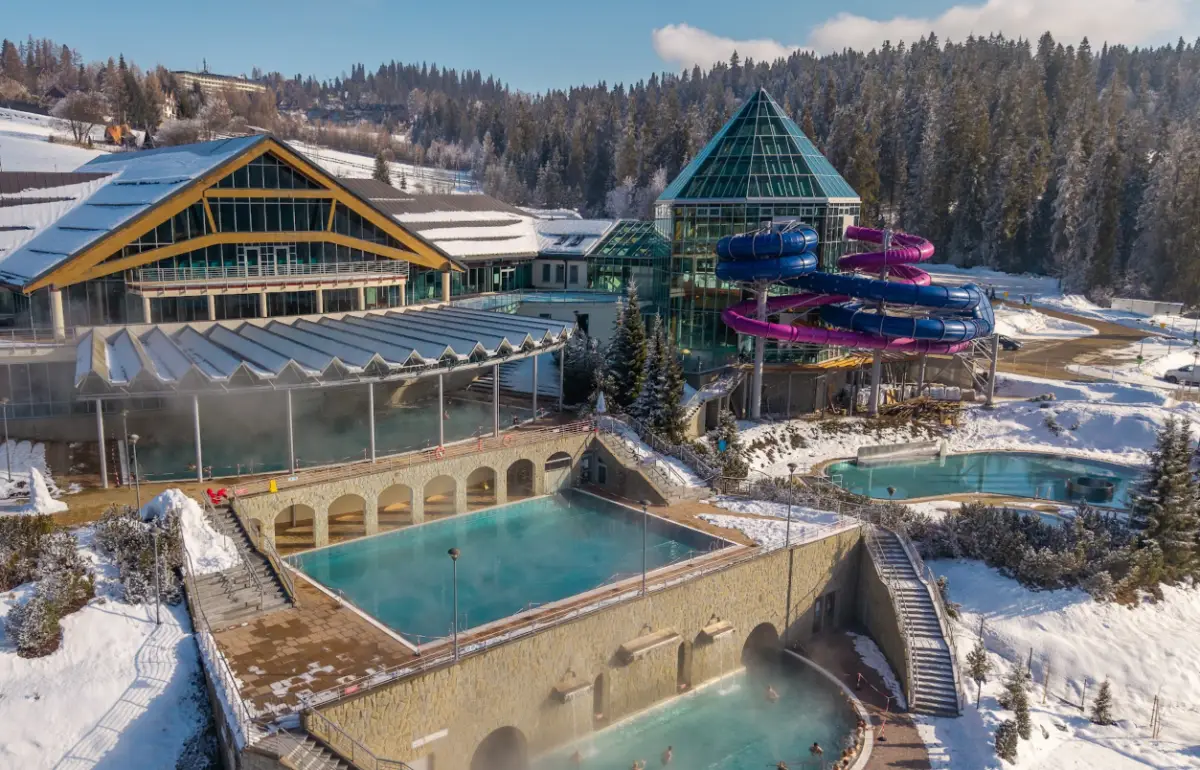
Just a few years ago, thermal baths were associated by Poles mainly with trips abroad – to Hungary, Austria, or possibly Slovenia. Today, the situation looks completely different. Domestic thermal complexes are breaking visitor records, and thermal baths in the mountains have grown into one of the most sought-after destinations for a weekend getaway. Despite this, a large group of people still has not had the opportunity to experience bathing in geothermal water. If someone is considering such a trip for the first time, they have come to the right place – because in this article, we gather the most important information to help plan it wisely.
Why Are Thermal Baths in Podhale So Popular?
Podhale is one of the few regions in Poland where geological conditions allow for the extraction of thermal water with a truly rich mineral composition. Deep rock layers heat the water and saturate it with elements that have proven therapeutic effects. Once extracted, the water flows into pools where guests can enjoy its therapeutic properties – without chlorine and artificial additives typical of regular swimming pools.
There is also the matter of the surroundings. Bathing in warm water against the backdrop of the Tatra Mountains panorama is something no urban water park can replicate. In winter, the contrast between hot water and freezing air stimulates circulation and provides an almost surreal experience. In summer, thermal baths become a natural complement to full-day hikes along mountain trails.
The Composition of Thermal Water – A Topic Too Often Overlooked
When choosing a thermal complex, it is worth starting not with pricing or location, but with one specific question: where does the water come from and what exactly does it contain? The quality of thermal water is absolutely fundamental. Genuine thermal water – the kind that reaches the surface at temperatures above 20°C – differs from ordinary pool water primarily due to its mineral content.
Truly valuable geothermal water contains, among others, potassium, magnesium, calcium, iron, silicon, sulfur, selenium, and lithium. Regular bathing in such water helps relieve rheumatic pain, improves skin elasticity, supports muscle recovery after physical exertion, and has a relaxing effect on the nervous system. Importantly, the deeper the water source, the richer the mineral composition generally tends to be. This is not a matter of marketing, but of geology.
How to Choose Thermal Baths Wisely for the First Time?
The abundance of offers can feel overwhelming, especially for someone who has never visited thermal baths before. A few simple guidelines can make the decision easier:
- Verify the water source – the facility should openly provide information about the depth of extraction and mineral composition
- Choose a larger complex – smaller thermal facilities can become unpleasantly crowded, especially on weekends and during school holidays
- Check what is available beyond the pools – saunas, steam baths, and SPA treatments significantly improve the quality of the experience
- Allow yourself enough time – two hours is definitely too little; ideally, plan at least half a day
- Read reviews – Google reviews are the quickest and easiest quality filter
First impressions truly matter. They determine whether thermal baths become part of someone’s regular relaxation habits or are forgotten after a week.
BUKOVINA Thermal Baths – Why So Many Positive Reviews?
Among thermal facilities in Podhale, one place appears in recommendations particularly often. BUKOVINA Thermal Baths in Bukowina Tatrzańska have been operating since 2008 and, over nearly two decades, have built a reputation that is genuinely difficult to challenge. Their key advantage is thermal water sourced from a depth of up to 2,400 meters, containing 28 mineral components – an achievement very few facilities in this part of Europe can boast.
The complex was designed with different types of guests in mind. Families with children will find an aquapark zone with impressive water slides. Couples can appreciate massage bookings for two and the comfort of the four-star Hotel BUKOVINA with direct access to the pools. Those focused on deep regeneration can take advantage of the extensive sauna area, steam baths, jacuzzis, and professional treatments at the Wellness BUKOVINA center.
A detailed overview of the advantages of this place, from water quality to practical advice for first-time visitors, can be found in the article on https://www.termybukovina.pl/blog/termy-w-gorach-sprawdz-dlaczego-termy-bukovina-to-najlepszy-wybor-na-pierwszy-raz, and it is definitely worth reading before planning your trip.
Bukowina Tatrzańska – A Quieter Alternative to Zakopane
Location is another argument that tips the scale. Bukowina Tatrzańska is located just several minutes’ drive from Zakopane, yet offers a completely different atmosphere. Fewer tourists, more space, and none of the crowds stretching through Krupówki Street. The village is one of the highest-located settlements in Poland, making it an excellent base for both easy family-friendly routes and more demanding mountain trails.
A day structured around hiking in the morning, recovering in thermal pools in the afternoon, and sitting down for dinner with a mountain view in the evening is, for many guests, the definition of a perfect vacation. And it is hard to disagree.
When to Go? The Best Seasons for a Thermal Bath Debut
There is no bad time for thermal baths in the mountains – every season has its advantages. In winter, there is the magic of nighttime bathing in hot water while temperatures drop below freezing. Spring brings blooming Tatras and increasingly longer days. Summer offers the full range of outdoor activities, while autumn brings golden scenery and lighter tourist traffic. Experienced visitors, however, recommend weekdays, when thermal baths are pleasantly calm and it is truly possible to focus on relaxation.
More Than a Temporary Trend
Interest in thermal baths in Poland has been steadily growing for years, and there is nothing to suggest that it will slow down. Regular balneotherapy brings real benefits – from improved joint mobility to reduced cortisol levels. Thermal baths in the mountains also offer something no city swimming pool can provide: contact with nature, silence, and the feeling that time finally slows down. Those who experience it once in a well-chosen place tend to return – a pattern repeated by thousands of Podhale visitors every year.